易飞迅
About Us
Highly Customized Solutions > Industry Solutions > High-end Textiles

High-end Textiles

Make Textile Warehousing and Logistics Soar

I. High-end Textiles | High-end Textiles | Industry Challenges

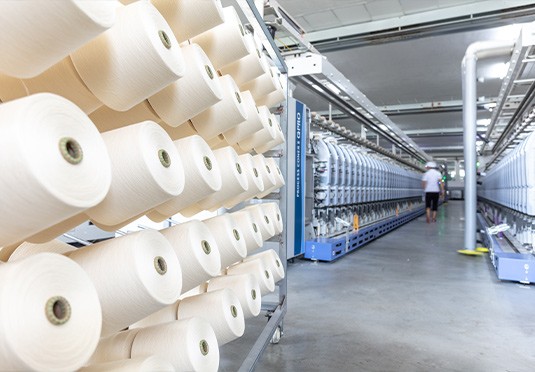
As a traditional light industry in China, the apparel and textile sector plays a crucial role in promoting national economic development, improving living standards, and providing employment opportunities. For a long time, the level of automation and the application of intelligent equipment in the textile industry has been relatively low. With the combined effects of a weakening market, rising raw material costs, and increasing labor expenses, the formerly labor-intensive industry is gradually shifting toward technology-intensive development. Traditional mid-to-low-end textiles are transforming into high-end textiles, and smart warehousing has become an essential part of the digital transformation for many textile enterprises.

High-end Textiles

II. EFX | Scenario-Based Solution

  • Apparel and Textile Industry

    Highly customized smart warehousing solutions

  • Glove textile industry

    Highly customized smart warehousing solutions

III. Successful Case | Smart Warehousing Empowers Traditional Textile Industry and Enhances Productivity at Dadong

1. Timeline

1) First inquiry: December 2023; 2) Contract signing: January 2, 2024; 3) Delivery: June 2024

2. Project Background

Nantong Dadong Co., Ltd., part of Jiangsu Inray Group, was founded in May 1987 as a Sino-Japanese joint venture with Inray Corporation of Japan. The company operates a full set of advanced international towel production lines, including pulping, weaving, bleaching, dyeing, sewing, embroidery, and finishing. Annual production reaches 5,000 tons of dyed, printed, yarn-dyed, jacquard, cut-pile, and embroidered towels, with products mainly exported to Japan, the United States, the EU, Hong Kong, and Taiwan. The company owns the registered trademarks "DD," "NT," and "Aisen," with the "DD" series recognized as a "China Famous Brand Product."

This project involves the fabric roll storage warehouse at Dadong’s Vietnam factory. EFX closely analyzed the industry characteristics and customer pain points to provide automation support for the Vietnam facility. After receiving the client’s requirements, EFX quickly responded and dispatched technical specialists to Vietnam for on-site research, providing a practical and reliable solution based on firsthand data.

3. Solution

EFX highly customized finished goods warehouse solution

Temporary fabric roll storage warehouse addresses the client’s previous challenges of difficult storage and inventory counting, improves on-site environment, and enhances management efficiency.

4. System Hardware

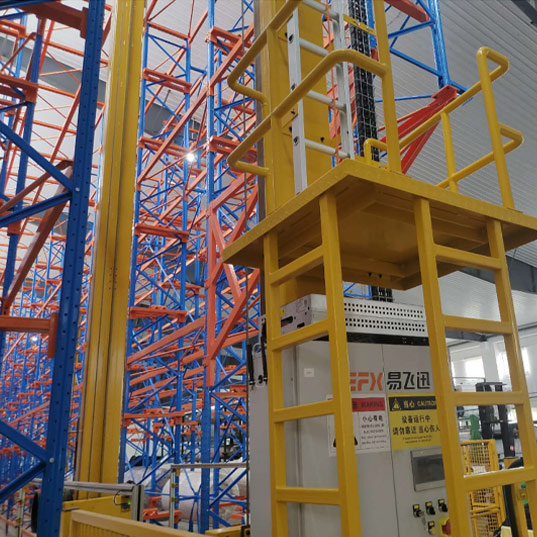
1) AS/RS: one temporary storage warehouse; two non-standard customized stacker cranes with a load capacity of 500 kg each; two sets of customized in/outbound turnover equipment.

IV. Project Challenges Wheels Project

This project, a fabric roll storage warehouse at Dadong’s Vietnam factory, posed challenges in both time and distance.

V. Solution Implementation

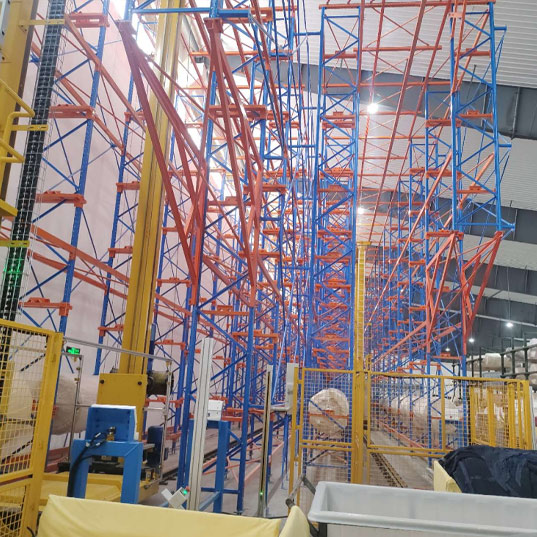
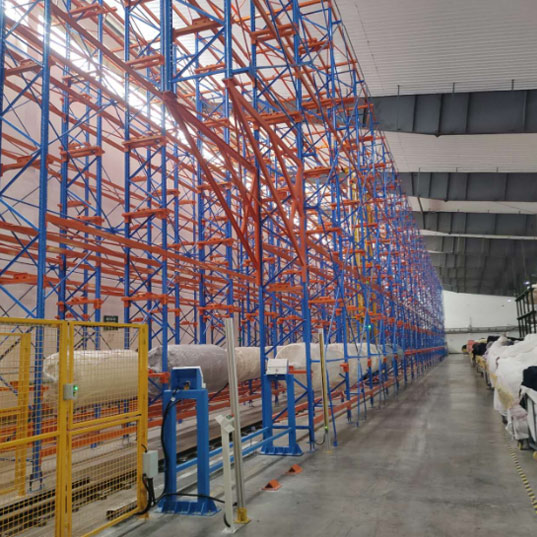
  • The warehouse is 10 meters high with a design load of 500 kg. Fabric rolls exceed 3 meters in length with a diameter of 1.2 meters. Equipment was manufactured domestically and then shipped to Vietnam for on-site assembly and commissioning. Key equipment used top-tier international brands to ensure operational stability. Forks were specially designed to accommodate the product structure, ensuring safe transport. The WMS software system was customized to integrate with the client’s MES system, enabling flexible, highly customized services beyond basic material storage to overall smart factory management.

    Solution Implementation
  • The inbound and outbound areas had limited space, and fabric roll dimensions over 3 meters prevented the installation of conventional conveyor equipment. After consultation with the client, special connection fixtures were installed at both ends of the warehouse, saving space and reducing project costs. Safety fences were also installed at the connection points to maximize operational safety.

    Solution Implementation
    Solution Implementation

VI. Project Delivery

Customer satisfaction is always our ultimate goal

The successful delivery of the automated fabric roll warehouse at Dadong’s Vietnam factory not only solved issues of limited storage space, difficult distribution, and inventory counting but also allowed operators to experience the productivity gains of automation and smart warehousing in traditional manufacturing. The smooth completion of this project received high praise from all levels of the client organization.

EFX will continue to support more international enterprises by providing reliable in-factory warehousing and logistics solutions, contributing to rapid business growth.

III. Successful Case | Smart Cross-Warehouse Integration for Multi-SKU Storage

1. Project Timeline

1) Initial inquiry:August 2025

2) Project implementation:March 2026

3) Project delivery:August 2026

2. Project Background

The client is a Shenzhen Stock Exchange-listed safety protection group founded in 2004 and headquartered in Nantong, Jiangsu. Its core businesses focus on hand protection and the R&D of strategic new materials. In 2025, the company generated nearly RMB 1.27 billion in total revenue. Building on a strong track record of cooperation and mutual trust, the two parties partnered again on a large-scale smart warehouse upgrade covering a broad operational scope. The project marks a new stage in the relationship—from point-specific optimization to deeper, system-level collaboration.

3. Solution Planning & Design

EFX Tailored Intelligent Finished-Goods Storage & Conveying Solution

Phase I warehouse is already in operation, while Phase II is a newly built facility. The project integrates the two warehouses and establishes coordinated material flow between Workshop 1 and Workshop 2.

4. System Configuration

1) Automated Storage and Retrieval System (AS/RS):16 double-deep, twin-mast stacker cranes; 19 m high; rated load 1,000 kg; graphical HMI operation.

2) Conveying System:Chain conveyors, roller conveyors, transfer units, RGVs, and multiple inter-floor lifts.

3) Software:

WMS / WCS

IV. Project Challenges Wheels Project

Challenge 1: Long-Distance Cross-Warehouse Transport

The existing Phase I warehouse needed to operate seamlessly with the new Phase II warehouse, while material flows between Workshop 1 and Workshop 2 also had to be connected. Because the warehouses and workshops are far apart, relying on a single-track RGV for long round trips would create long cycle times and disrupt the overall logistics rhythm, becoming a major throughput bottleneck.

Challenge 2: 19 m Warehouse Height and Multi-Level Workshop Layout

The Phase II warehouse reaches 19 m, while the production workshops are distributed across different floors. The significant height differences between the warehouse ground level and workshop floors make vertical transport difficult. A conventional solution would require repeated lift transfers, adding process steps and reducing efficiency, while preventing stacker cranes from serving different floors directly.

Challenge 3: Integrating Legacy and New Systems Across Multiple Equipment Types

The project combines construction of the Phase II AS/RS, retrofit of the Phase I AS/RS, installation of workshop conveyor lines, and production-trolley transfer. The existing stacker-crane and corridor-conveyor control programs in Phase I had to be replaced with the new EFX control system, despite differences in communication protocols and control logic. At the same time, loop RGVs, stacker cranes, lifts, and conveyors had to operate under unified scheduling. Without robust system integration, command conflicts and data synchronization issues could easily occur.

V. Solution

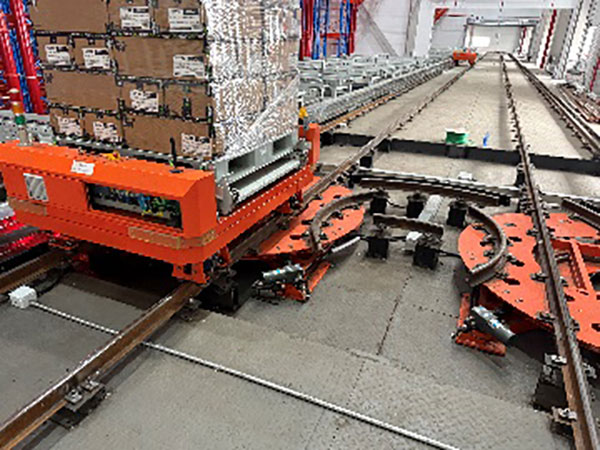
  • Deploy Track-Switching RGVs to Build a Flexible Loop Conveying Network

    A loop RGV system with track-switching capability enables vehicles to move flexibly between multiple rail sections. Long-distance transport is divided into shorter relay segments, reducing single-cycle travel time and improving material flow between warehouses and workshops.

    Solution
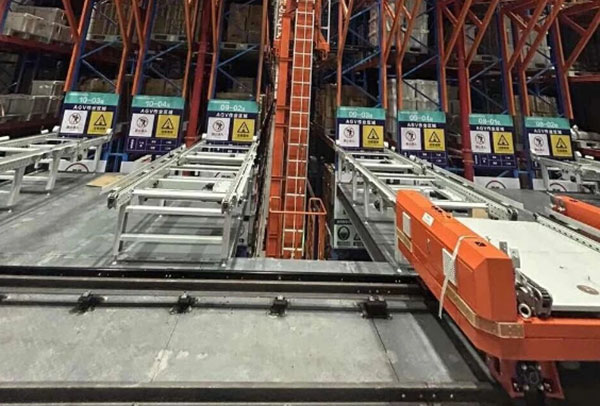
  • Add Steel Platforms for Direct Multi-Level Stacker-Crane Handling

    Steel platforms were installed inside the warehouse so stacker cranes can pick up and place loads directly at both Level 1 and Level 2. These platforms connect warehouse and workshop conveyor routes across floors, allowing cross-level handling without intermediate lift transfers. This shortens vertical transport paths and creates a more direct warehouse-to-workshop flow.

    Solution
  • Unify the Electrical Control Platform with a PROFINET-Based Architecture

    A centralized-management, distributed-control approach was adopted, with Siemens PLCs as the core controllers and PROFINET as the common industrial network. All equipment is coordinated through a unified control platform, allowing new and legacy systems to exchange data under a consistent communication protocol. The Phase I control programs were also fully replaced, eliminating incompatibilities between heterogeneous systems and ensuring stable command execution and system operation.

    Solution

VI. Project Delivery

The successful delivery of this smart warehousing project creates significant value for the client:

Internally, it removes key efficiency bottlenecks associated with traditional warehousing for PPE products, enables end-to-end automation and full-lifecycle quality traceability, and substantially reduces warehouse operating costs—strengthening the company’s long-term operational competitiveness.

Externally, the project demonstrates a replicable smart-transformation model for the industry. Cross-warehouse integration, track-switching RGV transport, and direct multi-level handling provide a practical path from labor-intensive material movement to data-driven logistics.

The successful completion of this large-scale project also validates the two parties’ ability to collaborate on complex system integration and marks a new phase of system-level partnership beyond isolated process improvements.

联系我们
联系我们
浏览至顶浏览至顶 联系销售Contact