

易飞迅
About Us
Highly Customized Solutions > Industry Solutions > Automotive Components

Automotive Components

Make Automotive Warehousing and Logistics Soar

I. Automotive Components | Automotive Components | Industry Challenges

Driven by national policies and the development of new energy battery technologies, China’s new energy vehicles have surpassed a century of automotive development in Europe and the United States. However, the supply chain management of automotive components is extremely complex. Data shows that a single OEM typically needs to manage tens of thousands of automotive parts. Due to the non-standardized nature and complex processes of the automotive parts industry, warehousing management faces significant challenges. For automotive component manufacturers, material inbound and outbound, order management, inventory management, and product traceability are all critical areas of concern.
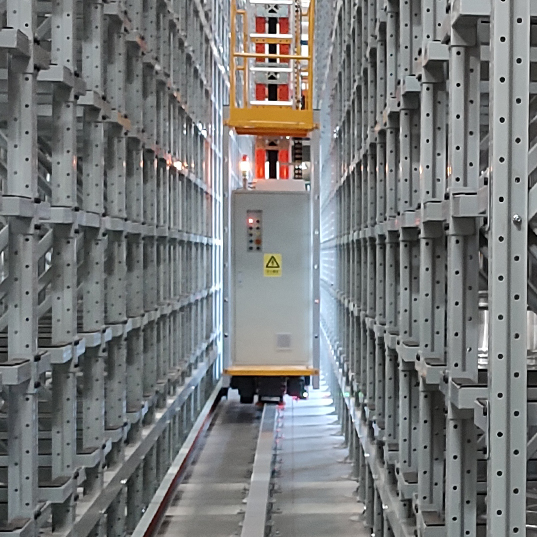
Automotive Components

II. EFX | Scenario-Based Solution

  • Wheel Industry

    Highly customized smart warehousing solutions

  • Auto parts

    Highly customized smart warehousing solutions

III. Successful Case | EFX Helps Jinfei Wheels Achieve Dual Benchmark Project

1. Timeline

1) Cooperation time: September 2022; 2) Delivery time: October 2023

2. Project Background

Jinfei Holdings Group Co., Ltd. was founded in 1959 and is headquartered in Wucheng District, Jinhua City. Since 2000, it has been listed as a key enterprise supported by the Jinhua municipal government and has successively been awarded titles such as China's Top 500 Manufacturing Enterprises, China's Top 500 Private Manufacturing Enterprises, China's Top 100 Automotive Parts Enterprises, Leading Enterprise in China's Motorcycle Parts Industry, Leading Enterprise in China's Automotive Wheel Industry, Zhejiang Top 100 Manufacturing Enterprises, Zhejiang Industrial Leading Backbone Enterprise, Zhejiang Management System Certification Demonstration Enterprise, and Zhejiang Standard Innovation Enterprise.

The smart warehousing project of Jinfei Wheels is a pilot project created by the enterprise, intended to become a dual-benchmark project for both the wheel hub industry and the Jinhua region.

3. Solution

EFX highly customized smart warehousing system solution

1) Fully automated from production line to storage warehouse; 2) Complete information flow from production line to shipment.

4. System Equipment

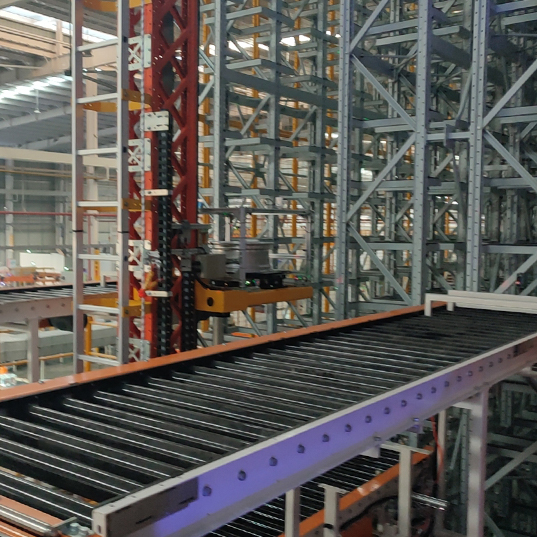
1) AS/RS: Two warehouses for blanks and semi-finished products, equipped with six Miniload stacker cranes. Each stacker crane has a load capacity of 50 kg, a height of 11 m, and an efficiency of 100 units per hour at 85% utilization.

2) Pre-warehouse conveyor and sorting system, equipped with a 200-meter tote conveyor sorting line

3) Software: Warehouse Management System (WMS)

IV. Jinfei Wheels Project Challenges Wheels Project

After fully understanding the customer’s requirements, EFX identified two major challenges due to the appearance material and individual weight of the wheels.

Project Challenge 1: How to prevent scratches when the forks directly contact the wheels?

Project Challenge 2: How to ensure safety during high-speed wheel transportation?

During the project planning and design, to completely solve the problems of scratches and the risk of wheels flying off, EFX conducted transport and storage experiments using Jinfei’s wheel samples on its own factory conveyor line. By simulating real scenarios and conducting extensive testing and data comparison, EFX mastered the wheel product trajectories and principles in automated warehousing, effectively resolving the issues.

V. How EFX Helped Jinfei Wheels Reduce Costs and Improve Efficiency

  • Improving contact surface materials and upgrading conventional fork materials to reduce cargo damage to zero!

    Before wheel hub products are put into storage, they are forked onto the conveyor line by forks. During this process, the forks come into direct contact with the wheel hubs and may cause minor scratches. The typical weight of wheel hubs ranges from 10 to 20 kg; the heavier the hub, the more severe the scratches caused by fork contact. Once scratched, the product becomes defective and must enter a rework process involving polishing, grinding, and repainting.

    Even a small scratch requiring reprocessing can significantly affect production schedules. To address this issue, EFX replaced the conventional hard contact materials on the forks with flexible materials wrapping the contact surfaces between the forks and wheel hubs, enabling damage-free contact and naturally reducing cargo damage to zero.

    How EFX Helped Jinfei Wheels Reduce Costs and Improve Efficiency
  • Increasing contact surface friction to ensure safe automated conveying and storage

    Each wheel hub weighs over ten kilograms, combined with a high conveying speed of 120 m/min, resulting in high gravitational acceleration during high-speed operation. Products may shift or shake multiple times during conveying. When conveyor lines transfer tracks, speed must be reduced to zero; the heavier the wheel hub, the greater the inertia, and there is even a risk of products being thrown off the track, further increasing cargo damage.

    After multiple simulation experiments and data analysis, EFX concluded that increasing the friction between the wheel hubs and the conveyor line, combined with precise fixed-point positioning within no more than 1 cm on all sides, can prevent positional changes during conveying and ensure safe storage and transportation.

    How EFX Helped Jinfei Wheels Reduce Costs and Improve Efficiency

VI. Project Significance

A multi-party win-win pilot project establishing a strategically significant value cooperation model.

The smart warehousing project of Jinfei Wheels is a multi-party win-win pilot project jointly created by EFX, academicians from Zhejiang Normal University, and upstream and downstream partners.

As an industry leader, Jinfei Wheels took the lead in completing a smart warehousing pilot project, with an increasingly significant benchmark-leading effect; the academician team from Zhejiang Normal University successfully completed research topics and project implementation applications; through this project, EFX established a strong reputation in the wheel hub industry and the Jinhua market, laying a solid foundation for diversified cooperation models in the future.

III. Successful Case | Smart Warehousing Strengthens Automotive Parts Supply Chains

1. Project Timeline

1) Initial Inquiry:November 2025  2) Contract Signed:January 2026 3) Delivery Date: August 2026

2. Project Background

Founded in 2010 and based in Nantong, Jiangsu Province, this technology company is a high-tech enterprise specializing in the R&D, manufacturing, and sales of precision metal components for the automotive industry. The company was listed on the Beijing Stock Exchange in 2023. Its main products include high-voltage terminals, solenoid valve housings, and various inserts, widely used in new energy vehicles.

3. Solution Planning & Design

EFX Customized Intelligent Storage & Retrieval Solution for Raw Materials and Finished Goods

This customized pallet-based AS/RS handles inbound storage, outbound retrieval, and picking for finished goods, semi-finished goods, and bar stock.

4. System Equipment

1) AS/RS:

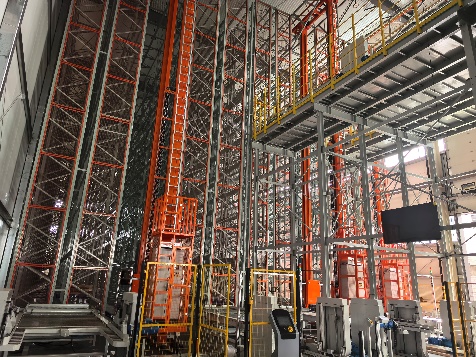
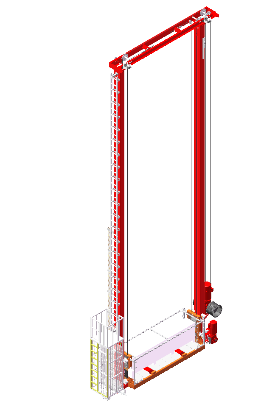
A double-deep, twin-mast stacker crane, 16 m high, with rated loads of 1,500 kg for finished and semi-finished goods and 700 kg for bar stock. The system provides 4,080 storage locations, raising storage capacity to more than three times the original level within the same footprint.

2) Conveyor System:

Includes chain conveyors, low-level lifts, turntable conveyors, profile inspection units, and other supporting equipment.

3) Software System

WMS/WCS

IV. Wheels Project

Challenge 1: Two-floor inbound and outbound operations make duplicated equipment too costly

The first and second floors each have independent warehouse operating areas. Under a conventional design, each floor would require its own equipment, significantly increasing capital cost, maintenance workload, and floor-space requirements - making the solution neither economical nor practical.

Challenge 2: Highly irregular load shapes are difficult for standard equipment to handle

Stored items include finished goods, semi-finished goods, and bar stock up to 3,500 mm long. Their wide variation in shape and size makes it difficult for standard stacker-crane forks to handle all non-standard loads safely and reliably.

Challenge 3: Mixed storage of multiple load types makes intelligent scheduling and accurate control more complex

The system must manage finished goods, semi-finished goods, and bar stock with substantially different pallet sizes (1,500 x 1,500 mm, 1,000 x 1,200 mm, and 3,500 x 500 mm), load limits (1,500 kg and 700 kg), and storage heights. Poor slotting can leave upper locations unused, increase equipment reversals, and create retrieval-route conflicts, significantly reducing overall throughput.

V. Solution

  • Steel Platform Connects Both Floors with One Integrated System

    By installing a steel platform between the two warehouse levels, the design creates a direct operating connection between floors, allowing a single stacker crane to serve inbound and outbound operations on both levels. This avoids duplicate equipment, controls investment, and maximizes the value of available space without compromising efficiency.

    Solution
  • Custom EFX Stacker Crane Engineered for Bar Stock

    Drawing on nearly 20 years of logistics equipment R&D experience, EFX developed a dedicated stacker crane for bar stock. A customized fork structure and handling method accommodate long, slender loads that are prone to rolling, enabling safe handling and efficient coexistence of non-standard materials and standard palletized goods within one system.

    Solution
  • WMS + WCS Coordination Enables Flexible, Intelligent Slotting

    The project integrates WMS warehouse management and WCS equipment control and monitoring. The system automatically assigns locations using strategies such as heavier loads at lower levels, flexible zoning by category, and FIFO outbound rules. During put-away, identical SKUs are distributed across locations to balance access and improve throughput; during retrieval, earlier-received inventory is prioritized. The WMS also provides standard interfaces to MES/ERP, keeping warehouse data and production plans synchronized in real time.

    Solution

VI. Project Results

Designed to meet the stringent requirements of the NEV supply chain, the project upgrades warehouse capabilities through automation and digitalization. Its value is reflected in three areas:

Operational: High-density AS/RS design maximizes vertical space and raises storage capacity to more than 3.5 times that of a conventional warehouse. Stacker cranes combined with intelligent scheduling improve inbound and outbound efficiency, while WMS/WCS integration provides real-time inventory visibility and full traceability. Delivery accuracy reaches 99.9%.

Financial: Automation significantly reduces reliance on manual labor, lowering labor costs by an estimated 40%-50%. It also prevents handling-related product damage and keeps physical inventory aligned with system records. The investment is expected to pay back within several years of operation.

Strategic: The project is a key step toward becoming a provincial-level smart factory. Deep integration between WMS and MES/ERP connects warehouse and production information flows end to end, providing robust logistics support for future capacity expansion and customer fulfillment.


联系我们
联系我们
浏览至顶浏览至顶 联系销售Contact