-
3D vision sorting to create a new industry benchmark for automated warehousing projects.
Fuda Alloy has a wide variety of products with different standards and specifications. Accordingly, shelf layer heights and load capacities vary, requiring materials to efficiently, rapidly, and accurately complete depalletizing, grasping, classification, and repalletizing operations on the conveying line before inbound storage. In this project, EFX adopted 3D vision robots. By combining three-dimensional visual imaging with digital sensing technology, the robots accurately identify products and quickly output product position, posture, and dimensions, guiding precise robotic grasping for palletizing, classification, and inbound sorting.
Through the 3D vision robot solution provided by EFX, Fuda Alloy’s smart warehousing project has become a new local model and an industry benchmark.
-
Improving quality, reducing costs, and increasing efficiency through innovative four-way shuttle material conveying concepts.
The fundamental objective of building smart warehousing for enterprises is to improve quality, reduce costs, and increase efficiency in material storage and transportation processes, and the Fuda Alloy project is no exception. In many non-standard projects, material transportation and inbound operations often follow a sequence, which can result in idle time for four-way shuttles, preventing maximum utilization of equipment. Considering project budgets, making reasonable use of four-way shuttles during idle periods—when they are not performing inbound shuttling—to undertake part of the material conveying tasks can reduce the need for at least one additional conveying line or several AGVs, thereby lowering unnecessary investment costs. This represents a flexible and practical solution.
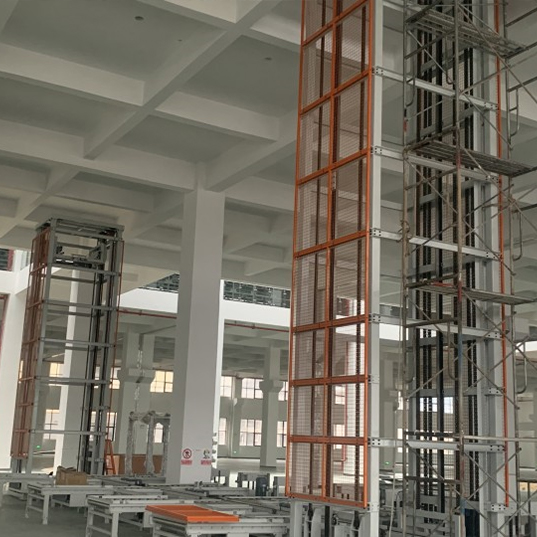
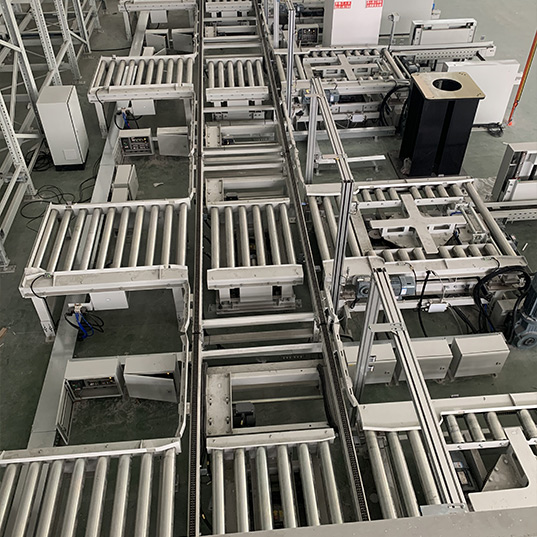
In the Fuda Alloy project, by adopting a four-way shuttle AS/RS, EFX extended the shuttle rails to the conveying lines, enabling the shuttles to complete part of the inbound conveying tasks during idle time, ultimately greatly improving equipment utilization. A small creative improvement fully demonstrated the effects of improving quality, reducing costs, and increasing efficiency.
-
System AI algorithms introducing a new model of dynamic weight-based location management.
Due to limitations of the warehouse’s civil structure, storage locations and load-bearing capacity faced significant challenges. The specifications of copper alloy products (size and weight) have a substantial impact on shelf layer heights, load-bearing capacity, and layout. During stacking, some shelves may not reach full load capacity, while others may risk overload. Without resolution, neither safety nor high-density storage could be effectively ensured.
To address this issue, EFX and Fuda Alloy held intensive discussions, revised the solution, controlled material flow, and increased storage locations. Ultimately, based on system algorithms, they established a principle of dynamic weight-based storage locations for Fuda Alloy, increasing dynamic weight allocation to resolve the actual load-bearing issues of the second-floor warehouse. This achieved two goals at once: maximizing shelf load storage while fully ensuring safety.
-
Eliminating information silos and building a fully closed-loop ecosystem for material production, transportation, and storage.
Generally, when enterprises build digital system architectures, later-introduced systems must be compatible with previously implemented core systems to achieve mutual compatibility and efficient operation.
EFX’s self-developed Warehouse Management System (WMS), through open interfaces, seamlessly integrated with Fuda Alloy’s existing ERP and newly introduced MES systems. This broke down information silos across different operational segments, ensuring that information from each segment is no longer isolated and enabling a fully closed-loop ecosystem with visible processes, automatic control, and intelligent management across production, conveying, and storage.


 EN
EN